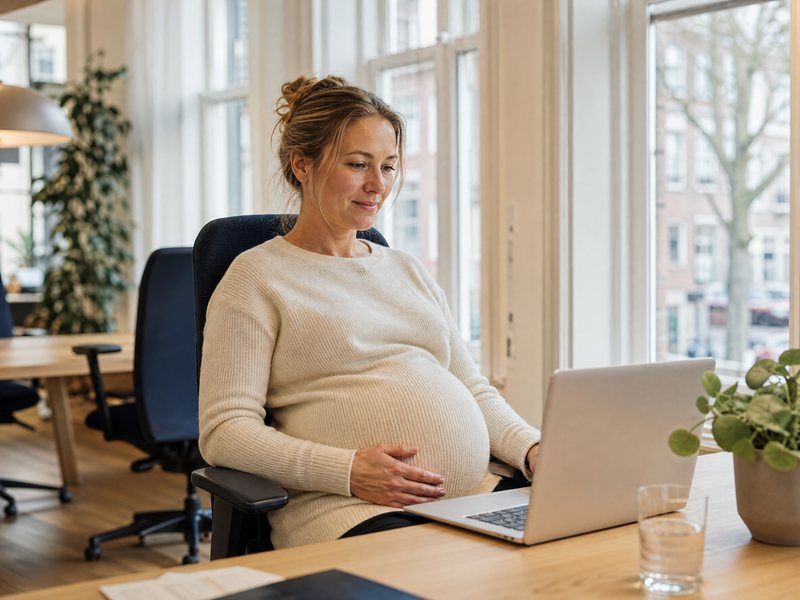

Maternity leave in the Netherlands: the basics
Maternity leave in the Netherlands lasts at least 16 weeks and is funded by a benefit from UWV (the Dutch employee insurance agency), not by the employer. The rules are in chapter 3 of the Work and Care Act (Wet arbeid en zorg, or WAZO). The leave has two parts: pregnancy leave (zwangerschapsverlof) before the birth and maternity leave (bevallingsverlof) after it. Your job as employer is to fix the dates, apply to UWV, run payroll and respect the protection rules.
- Start: between 6 and 4 weeks before the day after the expected due date (uitgerekende datum). The employee chooses. For twins or more: 10 to 8 weeks.
- After the birth: at least 10 weeks, starting the day after the birth.
- Total: at least 16 weeks, or at least 20 weeks for a multiple birth.
- Pay: UWV pays 100% of the daily wage (dagloon), up to a statutory maximum.
- No opt-out: no contract or CAO (collective labour agreement) can reduce these rights.
The Working Hours Act (Arbeidstijdenwet) adds a hard floor: you must make sure she does not work in the 4 weeks before the due date or the 6 weeks after the birth. Partner leave (geboorteverlof, aanvullend geboorteverlof) and parental leave (ouderschapsverlof) are separate schemes, covered in the guide to parental leave policies in the Netherlands.
How the maternity leave weeks are calculated
Count from the day after the due date. Pregnancy leave runs up to and including the day of the birth. Maternity leave then runs for 10 weeks, plus the days by which pregnancy leave fell short of 6 weeks (10 for multiples):
- Later start: starting 4 weeks before moves 2 weeks to after the birth.
- Baby born early: the missed pregnancy leave days are added after the birth, so the end date stays the same.
- Baby born late: pregnancy leave continues until the birth and the full 10 weeks follow. The total exceeds 16 weeks and the benefit covers the extra days.
- Sick before the leave: sick days in the 6 to 4 week window (flexibiliseringsperiode) count as pregnancy leave and are not added after the birth.
| Scenario | Before birth | After birth | Total |
|---|---|---|---|
| Starts 6 weeks before | 6 weeks | 10 weeks | 16 weeks |
| Starts 4 weeks before | 4 weeks | 12 weeks | 16 weeks |
| Baby 1 week early | 5 weeks | 11 weeks | 16 weeks |
| Baby 10 days late | 6 weeks + 10 days | 10 weeks | 16 weeks + 10 days |
| Twins, starts 10 weeks before | 10 weeks | 10 weeks | 20 weeks |
| Twins, starts 8 weeks before | 8 weeks | 12 weeks | 20 weeks |
| Baby in hospital for first 4 weeks of leave | 6 weeks | 13 weeks | 19 weeks |
Unless stated, the table assumes one baby born on the due date and leave starting 6 weeks before.
Baby in hospital. If the newborn is admitted to hospital during maternity leave, the leave is extended by the hospital days from the 8th day of admission, up to 10 weeks. With a standard 10-week leave that means at most 9 weeks, as UWV puts it. She gives you a hospital statement; you request the extension from UWV.
Spreading the last weeks (gespreid opnemen). She may ask to take the weeks that remain after the first 6 weeks of maternity leave in parts, spread over 30 weeks, for example by working part-time. She must ask within 3 weeks of the start of maternity leave. You must agree within 2 weeks unless a weighty business reason (zwaarwegend bedrijfs- of dienstbelang) stands in the way.
Maternity pay and the UWV application
How much UWV pays
The pregnancy and maternity benefit (zwangerschaps- en bevallingsuitkering, or WAZO benefit) is 100% of the daily wage. UWV takes her social security wage (SV-loon) over roughly the previous 12 months, including holiday allowance, and divides it by 261. A recent pay rise is only partly reflected. The benefit is paid for every weekday.
The daily wage is capped at the maximum daily wage (maximumdagloon): €309.91 gross per day from 1 July 2026 (€304.25 from 1 January 2026), including holiday allowance. The cap is reviewed every 1 January and 1 July, so check the UWV maximum daily wage page before you budget.
Salary and top-ups
By law you owe no salary during the leave (article 7:629(4) Dutch Civil Code). On the application you choose who UWV pays. Usually that is the employer, who keeps paying salary as normal; UWV pays within 4 weeks of the leave start and then every 4 weeks. The WAZO does not oblige you to top up to full salary, as the Minister of Social Affairs confirmed in March 2026. A top-up becomes compulsory if your CAO, the contract or your handbook promises it. Decide your policy once and write it down.
Who applies and when
- Employee to employer: she gives you her leave start date at least 3 weeks ahead, with a pregnancy statement (zwangerschapsverklaring) from her midwife or doctor showing the due date. She reports the birth by the second day after it.
- Employer to UWV: you apply, not the employee, through the Verzuimmelder in the UWV employer portal (werkgeversportaal) or Digipoort, report type "WAZO-verlof". The window is 4 to 2 weeks before the leave starts; the legal deadline is 2 weeks before. See the UWV application page.
- Late application: UWV then only pays for leave within the year before the application date, unless it makes an exception.
Worked example: due date 15 March 2027
Sanne works full-time for the Dutch subsidiary of a US company on €6,500 gross a month plus 8% holiday allowance, no bonus, and has been employed for over a year. Her due date is Monday 15 March 2027 and she wants to start leave as early as possible.
- Day after the due date: 16 March 2027.
- Leave start: earliest 2 February, latest 16 February 2027. She picks 2 February.
- She must tell you by: 12 January 2027.
- Your UWV application: between 5 and 19 January 2027. Diarise 12 January.
- Born on the due date: maternity leave runs 16 March to 24 May 2027; she returns 25 May.
- Request to spread leave: by 6 April 2027.
- Notice ban: until 5 July 2027, 6 weeks after her return.
The money. Her SV wage for the reference year is 12 x €6,500 plus €6,240 holiday allowance: €84,240. Her daily wage is €84,240 / 261 = €322.76, above the cap, so UWV pays €309.91 per weekday. (This uses the cap in force since 1 July 2026; the 1 January 2027 cap was not yet published at the time of writing.) Sixteen weeks contain 80 weekdays:
- UWV benefit: 80 x €309.91 = €24,792.80 gross.
- Her own daily wage for 80 days: about €25,820.69 gross.
- Gap: about €1,028 gross for the whole leave, about €64 a week.
If you pay full salary, UWV covers about €24,793 and the top-up costs you about €1,028 gross, excluding employer payroll costs. If you only pass on the benefit, Sanne gets about €1,028 less than normal pay. A late baby extends both the leave and the benefit.
Sickness before, during and after the leave
Pregnancy-related illness has its own rules under the Sickness Benefits Act (Ziektewet). They work in your favour if you report on time.
- Sick because of the pregnancy, before the 6 to 4 week window: you keep paying wages and UWV pays a sickness benefit of 100% of her daily wage (capped), normally to you, from day one. Report within 6 weeks.
- Sick for any reason in the 6 to 4 week window: report by the fourth sick day. The same benefit applies; the sick days are deducted from the leave after the birth.
- Sick during the leave: no extra leave or benefit, and nothing to report to UWV.
- Sick straight after the leave because of the pregnancy or birth: report by the fourth sick day. UWV pays the benefit while the illness lasts, up to 104 weeks. Illness that starts later or has another cause falls under your normal sick pay duties.
Late reporting can cost a UWV fine of up to €455. Pregnancy-related sickness before the leave is not counted in the 2-year period of sickness during which you cannot give notice. Company doctor (bedrijfsarts) and reintegration rules still apply; see managing sick leave in the Netherlands.
Dismissal protection, holiday and pension
- Notice ban: you cannot give notice during the pregnancy, the maternity leave or the 6 weeks after she returns. If she is sick from the pregnancy or birth straight after the leave, the 6 weeks run from her return after that sickness. You may ask for a doctor's or midwife's statement confirming the pregnancy.
- Narrow exceptions: dismissal in the probation period, with her written consent, or summary dismissal for an urgent reason. Closing the whole business counts too, but not while she is on leave. Dismissal in probation because of the pregnancy is still discrimination.
- Court route: in the protected period a subdistrict court (kantonrechter) only dissolves the contract if the request has nothing to do with the pregnancy, or if ending it is in her own interest.
- Fixed-term contracts: the contract still ends on its end date, with the usual written notice of (non-)renewal a month before for contracts of 6 months or more. But pregnancy must not be the reason: unequal treatment because of pregnancy, childbirth or motherhood is direct sex discrimination under the Equal Treatment Act for men and women and article 7:646 Civil Code. The employee can ask the Netherlands Institute for Human Rights (College voor de Rechten van de Mens) for an opinion. If the birth is expected within 10 weeks after the contract ends, she keeps the UWV benefit and applies herself.
- Holiday: she accrues holiday over her full contractual hours during the leave, and leave days cannot be booked as holiday. Statutory days she could not reasonably take do not expire after the usual 6 months.
- Holiday allowance: the UWV benefit includes it. If you pay salary, keep accruing holiday allowance (vakantiegeld) as usual.
- Pension: a scheme rule that stops accrual during pregnancy or maternity leave counts as unequal treatment by law. Keep accrual running.
See also anti-discrimination in the Dutch workplace.
Health, breastfeeding and return to work
During pregnancy. Once you know an employee is pregnant:
- Your risk assessment (RI&E, the mandatory risk inventory and evaluation) must cover risks for pregnant and breastfeeding employees.
- Inform her about those risks and your measures within 2 weeks of her telling you.
- Adapt the work, then the hours, then offer other work. If none of that works, release her from work.
- She may take extra breaks of up to one eighth of her working time per shift, and paid time off for check-ups. She cannot be required to work night shifts (unless you show this cannot reasonably be avoided) or more than 10 hours per shift. Apart from the check-ups, these protections continue for 6 months after the birth.
Breastfeeding. Until the child is 9 months old, she may interrupt work to breastfeed or express milk as often and as long as needed, up to one quarter of her working time per shift. These breaks are paid working time. Where needed, provide a suitable private room that can be locked.
Coming back. Her contract continues unchanged during the leave, so she returns to her own job on the same terms. Moving her to a lesser role or passing her over for a pay rise or promotion because of the leave is pregnancy discrimination. Expect requests for:
- parental leave (ouderschapsverlof): see parental leave in the Netherlands;
- fewer hours under the Flexible Working Act (Wet flexibel werken). After 26 weeks of service she can ask in writing at least 2 months ahead. With 10 or more employees, you can refuse only for a weighty business reason, and if you have not decided 1 month before the requested start date, the request is granted.
Your maternity leave policy and HR checklist
Put in your policy or employee handbook: who to tell and who receives the pregnancy statement; whether you pay full salary or pass on the benefit, including pay above the cap; who files the UWV application, with an internal deadline of 3 weeks before leave; how spreading requests and breastfeeding breaks work; and how holiday, bonus and pension are handled.
HR checklist for each pregnancy:
- Confirm the due date and leave start in writing and diarise every deadline above.
- Update the risk assessment and brief her within 2 weeks.
- File "WAZO-verlof" at least 2 weeks before leave starts and choose who receives the benefit.
- Set up payroll: salary, any top-up, holiday allowance, pension and UWV reconciliation.
- Arrange cover, then plan the return: hours, breastfeeding room, flexible working requests.
What head offices abroad often get wrong: assuming the employer funds the leave (UWV does, up to the cap); assuming UWV replaces full salary for high earners; waiting for the employee to apply; booking leave as holiday; letting a fixed-term contract lapse because of the pregnancy; and planning a redundancy while the notice ban applies.
How HRhelp helps
We are a Dutch HR consultancy for international companies. Through HR Teams, our senior consultants:
- write or review your maternity and family leave policy against the WAZO and your CAO;
- work out the dates and pay for each employee, including any top-up above the UWV cap;
- prepare the UWV application and track every deadline;
- manage pregnancy-related absence with the company doctor through our sickness management support;
- advise on renewals, reorganisations and dismissal in the protected period through our labour law advice for international employers.
Want maternity leave handled correctly for your Dutch team? Book a Free Consultation